








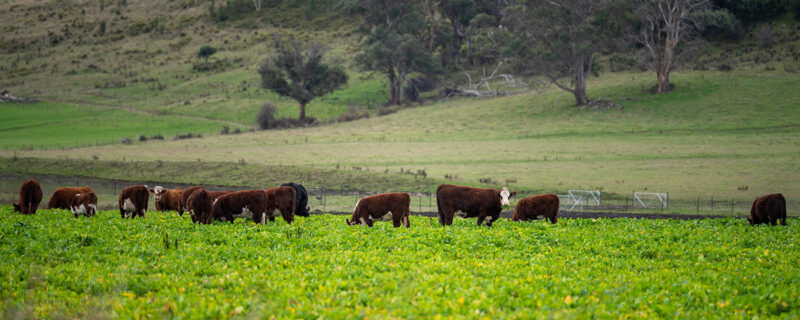
On 7 July 2026, the federal treasurer approved the sale of Rushy Lagoon after a Foreign Investment Review Board (FIRB) review that ran for more than six months. The farm covers 21,745 hectares near Cape Portland and runs four dairies. It’s the biggest farm in Tasmania, and it sold for more than $100 million (ABC News, 7 July 2026).
Two facts stand out in this sale. Firstly, one family held the property for 30 years. Secondly, the purchaser is a natural asset trust managed by a UK investment house. Their plan is to use the farm for softwood plantations, conservation and grazing. Money from outside the moat around Tasmania and Australia is flooding into our agriculture sector, and it is out of our control completely.
The practical question for every Tasmanian farmer is this:
What does it mean for my farm?
The Rushy Lagoon sale stands as another indicator that farms are no longer given monetary value by the families who work on them, or the returns they can make. Investors who do not live or work on farms are simply not attached to the land in the same way as multi-generational owners. This means that capital growth becomes more intertwined in decision-making around purchase and sale than ever before.
Outside capital continues to grow momentum
The compelling agricultural story in Tasmania continues to grow and evolve. This is being driven by reasonable rainfall in many regions, strong irrigation development, green branding, premium production and scarcity of other quality farmland.
To complement this, the buyer market is widening. Investments are flooding in from foreign investors, mainland and New Zealand investors, corporate farming groups, private equity, pension and superannuation funds, and carbon and natural capital investors. This is all adding to the momentum, which is consequently driving demand, that can only lead to one thing.
Higher farmland values
The exceptional growth over the last ten years in the value of Tasmanian farmland looks set to take a breath and then keep coming.
The good news is that balance sheets will strengthen, and farmer wealth will continue to grow. Borrowing capacity, and therefore terms, should also be stronger.
The bad news is expansion is getting harder. Additionally, the consideration of “Fair vs Equal” in succession becomes an even hotter point, and young farmers will find it even harder to penetrate the market.
Realistically, unless you are attracted to disposal, farmers are wealthier on paper and, as always, land values do not help cashflow.
Succession
As many farms are approaching generational handover, making success in succession come true will get a little bit more complicated. The “equal vs fair” proposition, created by the majority of family wealth being locked up in the farm and lower cash returns from farming compared to other investment options, continues to become more lopsided.
Equal distribution between the next generation taking over the farm vs the next generation looking elsewhere for their livelihood only happens in 5% of cases. This number will become even lower in the future. Where families decide the fairness line is has always been a contentious issue differing between families.
The only way to work through this problem is to start the conversation early (or better still, now) and make sure it is revisited often. As values rise, inflation continues and legislators make it harder capital gains concessions become less likely to be available. This leaves generational land transfer more difficult to achieve before farms reach estates.
Farm Management and Budgeting
As Ben Leditschke wrote in his article, “The numbers are your friend“,
“The Budget is the centrepiece to farm operations”
The impact on budgeting is significant. Farmers now need to budget for the true cost of capital tied up in land, higher debt levels, succession payments, lease alternatives and the return being generated per hectare. Should there be a capital budget and an operational budget?
Cost inflation may follow land inflation with wages, water entitlements, machinery demand –particularly in irrigation – all impacted by potential inflation.
A farm may still be profitable in cash terms, but when the underlying land value doubles, the return on assets can look very different. When the return on assets falls this affects expansion, borrowing and long-term planning because more capital is tied up in the same business. It forces farmers to ask whether the farm is productive enough, whether debt levels are sustainable, and whether the next generation can afford to take it on.
Final Thoughts
The farm may be worth more than you think. But value alone is not a plan.
Higher land values can create opportunity or risk. They can fund retirement, support smoother succession, reduce debt and unlock growth. They can also make generational transition harder, expansion more expensive and tax planning critical.
The Rushy Lagoon sale should be a prompt for every farming family to sit down with their trusted advisors and family and ask:
- What is our number?
- Where are we going?
- How do we get there?
- What is our plan to get there?
Don’t delay, get in touch today.
At Moore Australia we have a long history of successful succession facilitation. Please do not hesitate to reach out if you would like assistance in this area. It is one of the most satisfying services we provide; to enable a family to walk through generational change.