








Your accountant, your lender and your agronomist all work with your numbers. But none of them measures your true profitability. That job belongs to you – and here’s how to do it.
Your advisers aren’t measuring your profit
It’s not your accountant’s job to calculate your farm business’s profitability. The profit and loss they prepare is for the Australian Taxation Office (ATO). It’s a compliance document, not a measure of true profitability.
It’s not your agri lender’s job either. Banks are interested in debt serviceability and security – which is very different from business profitability.
Nor is it your agronomist’s or livestock consultant’s. They may calculate gross margins for your enterprises, but gross margins take no account of overheads, depreciation, interest or the value of your own labour.
So who is calculating your business’s profitability? None of your advisers are. It’s your business, and knowing your profit is your responsibility. After all, you can’t manage what you don’t measure.
Why true profit matters
1. It tells you whether your business is truly viable. When you know how your business performs, you can improve where it counts. You can also compare your farm’s return with alternative investments, like ASX shares. If your capital can earn more elsewhere, that’s worth knowing – especially for smaller businesses with turnover under $250,000, which are rarely profitable.
2. It gives you choices. After tax is paid, profit gives you four choices:
- Repay debt. You can’t repay debt unless you’re making a profit and paying tax. Repaid debt is also a risk management tool – you can redraw in poorer years instead of going back to the bank.
- Reinvest in the farm. We assess on-farm investments against three criteria: do they make you money (irrigation, pasture development, a capital application of fertiliser),do they save you labour (efficient stock yards, automation, electronic identification) or do they keep your family and staff safe (replacing windmills with solar pumps). Assess profitability first and finance-ability second – your lender won’t tell you whether the investment you’re financing is a profitable one. That’s your responsibility again.
- Invest off farm. A holiday house, for example.
- Pay the owners better. A one-off bonus for an unexpected profit, or a lasting lift in family wages – for school fees, say – if the rise in profit is sustainable.
3. It keeps your bank on side. Banks lend more readily to profitable businesses. They will lend to unprofitable ones too while their ‘capacity to repay’ calculations stand up – but once profit erodes, so does your capacity to borrow. It’s better to be profitable for your own sake, not just the bank’s.
What is true profit?
True profit is more than having extra cash at the end of the year.
Say you began the year with 200 cows and ended it with none. Is the extra cash in the bank the result of good management, or of selling down the herd? That’s why we look at every source of income – cash income plus non-cash income, like changes in livestock and grain inventory – and every expense, cash and non-cash, including depreciation and the real value of the owners’ labour and management, not just drawings.
The result is your true profit: the return your own efforts have earned. We express it as a return on the total assets you manage – your return on assets (ROA). The higher, the better. The question to ask yourself is: “Am I getting enough profit from the assets I’m managing?”
Won’t I just pay more tax?
Yes – and that’s a good thing. Without taxable profit, the four choices above aren’t available to you.
Minimising tax still matters. Use your accountant at tax planning time to optimise your taxable income, not eliminate it. A marginal tax rate of 10-20% is a good range to aim for. At that level there’s enough cash to pay the tax, and you still get to make your choice of the four. Banks want to keep lending to these businesses too. How did your accountant go at tax planning time this year in assisting your business to minimise your tax?
Measuring your own profitability
Your taxation profit and loss won’t tell you your true profitability, because some of its figures are derived for ATO purposes rather than reflecting reality. The same goes for your taxation balance sheet and your true equity position.
But your taxation financials are a good template. Once you know the differences between the tax viewpoint and the management (real) viewpoint, you can use them to project your real profitability:
| Document | Taxation viewpoint | Management (real) viewpoint |
| Balance sheet | Farmland at historical cost | Farmland at real values |
| Balance sheet | Livestock at ATO-derived values | Livestock at real values |
| Balance sheet | Machinery at ATO accelerated written-down values | Machinery at real values |
| Profit and loss | Depreciation at ATO accelerated rates | Depreciation at real rates |
| Profit and loss | Derived figures – lease or rent, owners’ salary or drawings | Only real leases and rents, plus the real value of owners’ labour and management |
What’s a good profit level?
Our benchmark has always been an ROA above 5%. Broadacre businesses commonly achieved it before spring 2023, when farmland values took off – a high ROA may even have been an early signal that land prices were about to rise?. Today we’re commonly seeing returns of 2-3%, or much less in broadacre farms.
3 ways to improve your profitability
If your ROA is below 5%, there are only three ways to lift it – in any business.
1. Increase turnover as a percentage of assets
Turnover is cash income plus inventory changes. We aim for a turnover ratio above 15% – that’s $15 of turnover for every $100 of assets under management. We are currently seeing ratios of 3-8%: half or less of the benchmark.
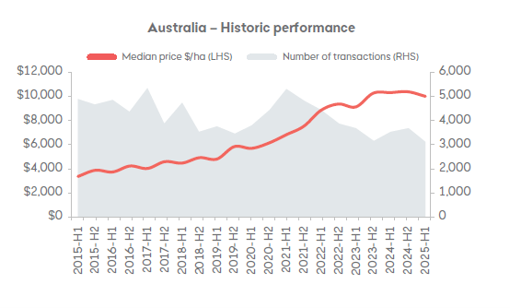
Dry seasons have cut income for some farmers, but not for all across south-eastern Australia. The main culprit for low turnover ratios is rising farmland values. Rural Bank’s Australian Farmland Values Report 2025 shows values have doubled since the first half of FY2019 – that’s a compound average growth rate of 12% a year for six years. Farmers are effectively farming real-estate-valued land.
2. Reduce overheads as a percentage of turnover
We aim for an overhead ratio below 35% – the lower, the better. The two most common causes of a high overhead ratios are too much machinery value (and depreciation) and too many family members drawing an income from the business. Neither is an easy conversation, and improving the ratio often calls for business redesign. But it can be done. Two guides help:
- Machinery. Aim for $1 of machinery value for every $1 of turnover. Too much machinery means working the asset harder – contracting, for example.
- People. Aim for $800,000 of turnover per full-time equivalent. Below that, a succession planning conversation may be needed to match the number of family members on farm to the turnover.
3. Increase your gross margin ratio
We aim for a total farm gross margin above 70% of turnover for grazing businesses, or above 65% for mixed farming. Volatile fertiliser and diesel prices and depressed grain prices have squeezed margins. We all know that.
It’s easy to blame world events, but farmers and graziers can take some responsibility here too – and once we accept responsibility, we can make positive changes. Question the gross margin ‘recipes’ your agronomist or livestock adviser gives you. Maximum production does not equal maximum profit: the maximum gross margin usually sits 10-15% below maximum production.
The ideal ratio is $1 of direct costs for every $3 of enterprise income, leaving a gross margin of $2 – or 66% of enterprise income is an ideal target. Design your livestock and crop gross margins with your advisers to these ratios. That’s both of you taking responsibility.
It’s your profit – measure it
Profit gives you choices. No one else is going to calculate it for you: it’s your farm business, and measuring and managing profitability is your responsibility.
We also recognise that all businesses are different and there is not necessarily a one-size-fits-all solution when it comes to measuring profitability and using ratios. The discussion about this provides a great guide, based on our experience working with multiple farming businesses but it is always important to look at the way your business works uniquely to get the best result.
Want to know your true profit? Get in touch today.