









With the first wave of mandatory sustainability reports now published and audited, organisations preparing for upcoming reporting cycles are understandably asking what good looks like in practice. The first sustainability reports published under the Australian Sustainability Reporting Standards provide valuable insight into how entities have approached their initial reporting cycle — and, importantly, what minimum compliance has looked like in reality.
Drawing on observations from early reports, audit experience and hands on implementation work, Moore Australia along with Pangolin Associates, recently held a webinar exploring these Sustainability Reports and several clear themes have emerged that should help organisations preparing for their first sustainability report.
Lessons from first time sustainability reports
One of the most useful insights from early reporters is what sustainability reporting actually looked like in practice. Reports were generally contained and pragmatic, most often embedded within the annual report rather than prepared as standalone sustainability publications. This reflects a clear focus on meeting mandatory requirements rather than producing expansive voluntary disclosures.
Strong reports paid careful attention to layout and structure. Governance organisational charts were frequently used to clearly describe roles, responsibilities and oversight, reducing lengthy narrative explanations. Climate related risks and opportunities were commonly presented using structured tables that outlined the nature of the risk or opportunity, whether it was physical or transitional, and the expected time horizon. These techniques improved readability and made it easier to draw connections across different disclosures.
Equally instructive was what organisations did not do. Scenario analysis was often limited to the two mandatory scenarios, with disclosures remaining high level and predominantly qualitative. Financial effects of climate risks were commonly explained narratively rather than fully quantified. Scope 3 emissions were frequently deferred under transitional relief, and climate related targets were not universally disclosed.
The key takeaway is that minimum compliance did not look like failure. Early reporters demonstrated that sustainability reporting can be proportionate, staged and well bounded in the first year, with additional sophistication to be built over time.
What auditors focused on
Auditor attention was broader than many organisations expected, though still grounded in proportionality. While limited assurance scopes matter, auditors reviewed sustainability reports as a connected whole, with auditor attention expanding beyond the narrow set of disclosures with mandatory assurance requirements. Sustainability reports were reviewed as a connected body of work, with emphasis placed on governance, risk management processes and the credibility of underlying methodologies.
Within scope, auditors focused closely on governance, wanting to see clear lines of accountabilities on climate related risks and opportunities from the board down, and evidencing of climate related skills at board and executive levels. Auditors are also staying very close to GHG (greenhouse gas) assessment with some concerns on possibly seasonality variations when approaches such as 9 (month actuals) +3 (months of forecast) were being used.
Outside anticipated assurance scope, auditors want detail on how climate related risks and opportunities were identified, assessed and reflected consistently throughout the report. Where data was available, there was often an expectation that risks — particularly transition risks — would be quantified at least internally as part of the assessment process, if not actually disclosed.
Auditors spent time considering the risk management process, as it fed into the identification of the climate-related risks and opportunities, and disclosed decarbonisation targets, where present, attracted heightened scrutiny due to governance expectations and greenwashing considerations.
Generally, auditors placed weight on documentation, judgement and consistency. A recurring lesson was the importance of the finance team being involved early, documenting assumptions clearly and engaging with your auditors proactively. These organisations were better positioned to respond efficiently to audit enquiries.
Practical experience in determining climate related risks and opportunities
A consistent message across early reporters was that determining climate related risks and opportunities is a process, and one you need to give yourselves enough time to complete well. In practice, effective approaches tended to follow three broad stages.
First, organisations clearly defined their parameters. This included setting time horizons, determining operating boundaries and clarifying what could reasonably be expected to affect the entity’s prospects. Strong parameter definition helped avoid overly broad risk inventories and provided a defensible basis for subsequent decisions.
Second, organisations developed a longlist of potential risks and opportunities. This stage benefited significantly from cross functional input, particularly from operations, procurement and strategy teams. Practical experience shows that many material risks do not sit solely within an organisation’s direct operations, but emerge through value chains, customers, workforces or insurers.
Third, entities refined this longlist to a substantiated shortlist. Scenario analysis and quantification were applied only to shortlisted climate-related risks and opportunities rather than exhaustively across all identified risks. Where reliable data existed, quantification was undertaken; where it did not, entities explained the limitations and provided targeted qualitative disclosures. Importantly, financial effect disclosures were aligned to the financial statements by identifying affected balance sheet and profit and loss items.
Experience across different sectors reinforced that using estimates, ranges and staged levels of analysis was acceptable — particularly in an entity’s first reporting cycle — provided assumptions and judgements were clearly documented.
What organisations should do now
The experience of Australia’s first sustainability reporters points to a clear path forward. Organisations should resist the temptation to aim for perfection in year one. Instead, effort should be focused on establishing robust foundations: identifying genuinely material climate related risks and opportunities, applying proportionality, engaging key internal stakeholders early, and building clear documentation that can withstand assurance scrutiny.
Sustainability reporting is not a one off compliance task. It is an evolving process that will mature alongside governance, data quality and strategic decision making. Organisations that start early, make defensible judgements and allow time for iteration will be far better placed to meet their obligations confidently and efficiently.
Moore Australia and Pangolin Associates both work closely with organisations at every stage of this journey, combining technical accounting, assurance and climate strategy expertise to support practical, fit for purpose sustainability reporting.
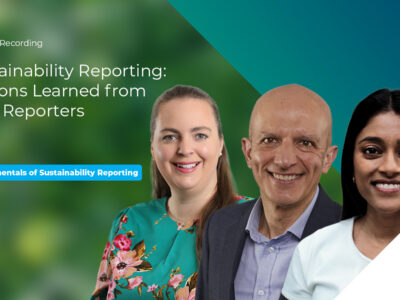
For those looking to explore these insights in more detail, watch the recording of the recent sustainability reporting discussion below:
Pangolin Associates is one of Australia’s leading climate consultancies, helping organisations decarbonise, and build resilience in a changing climate. Since 2010, Pangolin has been a trusted expert in emissions measurement, decarbonisation, statutory reporting such as NGER or ASRS— transforming complex data into actionable insights that drive both impact and performance.
About the Authors
Kristen Haines, National Head of Technical Accounting and Sustainability Reporting, Moore Australia
Kristen advises clients and teams on IFRS, sustainability and corporate reporting. With over 16 years’ experience, she simplifies complex standards for businesses of all sizes. A former AASB staff member and FSA credential holder, she supports practical implementation and delivers clear, tailored insights through publications and presentations.
Manny Vassal, Principal Consultant, Pangolin Associates
Manny has over 20 years of executive consulting experience and leads Pangolin Associates’ ESG, ASRS, climate and nature reporting services. He specialises in strategy, governance, risk, compliance and stakeholder engagement. Manny is working with C suite leaders and Boards across both the private and public sectors in Australia. He holds a Master of Engineering in Aeronautics, an MBA, and a Graduate Diploma in Environment and Climate Emergency.
Marionne Sooriakumar, Consultant, Pangolin Associates
Marionne supports clients integrating climate considerations into corporate strategy and risk management. Her work involves assessing climate risks and opportunities, including the quantification of potential impacts, to inform decision-making and ASRS compliance. She holds a Master of Sustainability, a Bachelor of Commerce and a Graduate Diploma of Chartered Accounting (CA ANZ).